Building Autonomy Through Training
Beyond the transmission of knowledge
In Guinea, Pierrette Chenevard put her expertise in adult education to work with Mercy Ships by training medical educators. Her mission reflects the organisation’s commitment—founded nearly 50 years ago in Lausanne—to strengthening the skills of local healthcare professionals for lasting impact.
A few months ago, Pierrette Chenevard flew from Geneva to Guinea-Conakry, as part of a humanitarian mission with Mercy Ships. Having worked as a Medical Delegate for the ICRC, then as Director of the Training Centre of H+ The Hospitals of Switzerland Association, and as a specialist in adult learning (andragogy), Pierrette Chenevard has dedicated most of her career to training, teaching and learning. It was in her role as a learning design specialist that she undertook this journey: to deliver training to around forty Associate Professors. On the verge of obtaining full professorships at the Gamal Abdel Nasser University of Conakry (UGANC), and originating from various countries across sub-Saharan Africa, these academics represented a wide range of medical disciplines, including dentistry, ENT, obstetrics and gynaecology, general surgery, neurosurgery, cardiology, urology and anaesthesiology.
A Lasting Investment
Far removed from traditional lecture-based teaching, the workshop, entitled “Teaching Differently – Interactive Approaches to Adult Education”, aimed to strengthen teaching capabilities through group exercises and learner-centred methods. Raphaël Yaradouno, Education Training and Advocacy Project Officer, supported the Swiss trainer throughout the programme. He recalls how, drawing on her extensive experience and expertise, she shared many thought-provoking insights during the training sessions. “Training someone is like planting a tree: it is only the beginning. You must then water it, nurture it and protect it until it bears fruit, and those fruits in turn give rise to other trees.”
This mission highlights a lesser-known aspect of Mercy Ships’ work. While the organisation is best known for providing free surgical care aboard its hospital ships, its work is also founded on a second pillar: the sustainable strengthening of local healthcare capacity through training and the transfer of skills.
Nine out of ten people in sub-Saharan Africa lack access to the surgical care they need.
At a time when nine out of ten people in sub-Saharan Africa lack access to the surgical care they need, Mercy Ships’ provision of surgical services, training programmes and health advocacy initiatives aims to reduce this inequality in a sustainable way.
Mercy Ships’ Dental Training Centre in Guinea
Investing in local healthcare professionals is an important cornerstone of long-term impact, and Mercy Ships’ work in Guinea illustrates this perfectly. Through the establishment of the Dental Training and Care Centre (Centre de Formation et de Soins odontologiques), developed in close partnership with UGANC, Mercy Ships trains dental students by incorporating practical clinical experience into their studies—an element that was absent from the curriculum only a few years ago.
Far more than a dental clinic, the centre is equipped with simulators, training mannequins for practical exercises, a laboratory for the manufacture of prostheses, and much more. In addition, a simulation centre dedicated this time to the entire Faculty of Health Sciences and Technology (FSTS) is currently under construction and will open on campus at the end of the year, significantly increasing capacity for patient care, clinical practice and training across all existing medical specialties.
Ana Filipa Coelho, a dentist and Mercy Ships Programme Officer in Guinea, applies her expertise across multiple areas: teaching, mentoring, providing dental care, and coordinating visits from international partners and specialists who travel to the training centre in Conakry to contribute to student education. Having met Pierrette Chenevard during a course in Cully (VD, Switzerland), she was inspired to invite her to Guinea to deliver this training programme on educational techniques.
Beyond the pedagogical tools that were shared, the training was also a deeply human experience. In an atmosphere of listening, respect and mutual encouragement—illustrated by activities such as the positive gossip exercise—participants were invited to reflect on their role as educators and on how best to guide their students towards greater autonomy and responsibility.
Before the end of the visit, David Ugai, Mercy Ships Country Director in Guinea, invited Pierrette Chenevard to return later in the year. Accompanied by experts from other fields, including aviation, infectious diseases and history, she will introduce an interdisciplinary approach that enables participants to step outside their professional practice while engaging in shared reflection. Moved by the commitment, support and warm welcome of David, Ana Filipa, Raphaël and their inspiring team, Pierrette reflected: “I experienced an extraordinary moment of humanity. It is for all these people that I want to come back.”


Towards Greater Autonomy
“Education is not limited to the transmission of knowledge; its purpose is to enable learners to become autonomous. ” - Pierrette Chenevard
By working with educators, Pierrette Chenevard contributes to a powerful multiplier effect. Training those who educate future doctors, surgeons and healthcare specialists is an investment in entire generations of professionals who will, in turn, care for thousands of patients.
Raphaël Yaradouno highlights the guiding principle that characterised the expert’s stay: “Education is not limited to the transmission of knowledge; its purpose is to enable learners to become autonomous.”
For Mercy Ships, initiatives of this kind perfectly embody its vision: not only to provide surgical care, but also to transfer skills and support local stakeholders so that progress continues long after the ship has departed.


the mission
of Mercy Ships.
- 2 July 2026
Derniers articles publiés

Humanitarian Relief in Madagascar after Cyclone Gezani
In the wake of Cyclone Gezani, Mercy Ships has joined national disaster response efforts in Toamasina to support affected communities with utgently needed relief supplies.
Update on the Situation in Madagascar, One Week After Cyclone Gezani
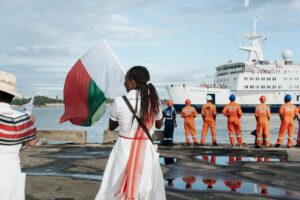
On February 10, Tropical Cyclone Gezani struck Madagascar, severely impacting the port city of Tamatave (Toamasina). As a long-standing partner in Madagascar, we recognize the profound impact this has had on families and communities across the region.
Physiotherapists from Sierra Leone aboard the Global Mercy
Through its programmes of medical capacity building,
Mercy Ships contributes to the development of the expertise of active professionals committed to improving surgical care in Sierra Leone.

Looking Back at the Key Moments in 2025
In 2025, we continued our mission by providing quality surgical care aboard our two hospital ships and strengthening our local partnerships. Mercy Ships Switzerland is deeply grateful for your support throughout the year.
Tags
Lire d'autres articles

Interview with Didier Reymond, SABC Founding Member
Following his retirement from his position as CEO of Webb Fontaine and having seen during many years the tremendous impact of Mercy Ships in several African countries, Didier Reymond served as dining staff on the Africa Mercy.

Physiotherapists from Sierra Leone aboard the Global Mercy
Through its programmes of medical capacity building,
Mercy Ships contributes to the development of the expertise of active professionals committed to improving surgical care in Sierra Leone.
The Africa Mercy is back in Madagascar
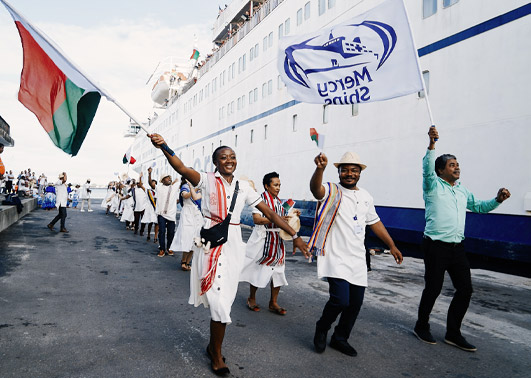
Mercy Ships is back in Madagascar to bring transformative surgical education and free, life-changing surgeries.